skip to main |
skip to sidebar
Art Gallery of Ontario (AGO) in Toronto, Canada is under construction for a Frank Gehry addition. By looking at the architectural model on display, one does not get the impression that it will be a blockbuster attraction like his Guggenheim in Bilbao, the Walt Disney Concert Hall in LA, or the Millenium Park in Chicago. It is an acknowledgement that Gehry was born and brought-up in this city. However the addition has been called Gehry-lite, due to the understated structure financed by a relatively small budget.
During the construction, a limited portion of the permanent collection is on view (mostly Impressionist paintings), including the largest collection of Henry Moore sculptures in the world. What's interesting is that the AGO invited British artist Julian Opie to draw figures on the walls of the Henry Moore sculpture center. You will remember Julian Opie from one of my MArch posts covering the Margulies Collection in Miami.


 Here Julian Opie created drawings of a stripping pole dancer surrounding the walls of the Henry Moore sculpture center. Named, This is Shahnoza, the drawings were conceived from photographs and videos of a real dancer, taken in the artist's studio. Julian Opie's trademark stick-figures create a playful dialogue with the serene sculptures of Henry Moore. Whereas Henry Moore's female figures exude elegance and gravitas, Julian Opie's drawings are cheeky and light.


You will also notice that the poles are drawn under the beams of the gallery, where they seem to be supporting the ceiling. They bring to mind the caryatids used in the Greek period as columns to hold up ancient temples (example below).
 The inter-generational dialogue with a master sculpture from the '60s and the historical/architectural reference make this temporary installation a unique experience.
In addition to its permanent exhibit, the Rubell Family Collection in Miami also presents themed, temporary shows, curated out of its own collection. Last winter they exhibited Poles Apart: Contemporary Polish Art. To be honest, I was skeptical going into the Polish exhibit: I did not know what to expect and did not want to get distracted away from the art by well-known artists. But I kept an open mind (artpup style) and proceeded through the exhibit. In the end I was pleasantly surprised. It was the discovery that made it so special - the sort of pleasure that you come upon unexpectedly.
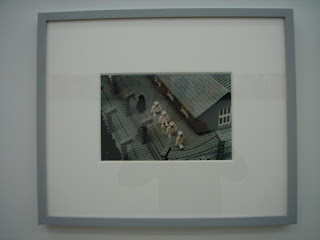
My favorite work was the Concentration Camp series of photographs by Zbigniew Libera. Please click to enlarge images for a better view.
 Here the artist constructed scenes from Nazi-era concentration camps using customized Lego pieces. The original limited edition Lego sets were not available at the Rubell exhibit, but the photographs of the sets were on display. The value of the work comes from the material. A very disturbing period of human history is presented in a lighthearted way using popular toy pieces. The innocence associated with children's toys contrasts starkly with the uncomfortable subject matter that it depicts. It lets you in on a dark period in Polish history, the terrorizing Nazi experience during WWII.


This post concludes my report from the Rubell Family Collection this year. I will be back next year to see new acquisitions and other work that gets unearthed out of storage in this revolving exhibition space. I tried to give you a flavor of the collection, covering a few highlights. The Rubell collection is massive, representing a broad range of well-known artists, from non-living contemporaries like Andy Warhol and Keith Haring to current stars like Elizabeth Peyton and Lisa Yuskavage. If you travel to Miami between December and May, make sure you visit the Rubell Family Collection. You will enjoy the experience.
Now that the weather is getting warmer up north, I am going to head up to Toronto and review a couple of works there.
 LA artist Kara Walker's work, named Camptown Ladies, is another controversial piece in the Rubell Collection. It is made up of silhouettes cut out of black paper and pasted on the wall. It is one of the best-known examples of her body of work that explore stereotypes about blacks and women with narratives from the old south and the time of slavery. The above piece is only a partial view of the installation that covers an entire wall. It finds inspiration in an old folk song from the mid-19th century, about workers racing horses for entertainment in make-shift towns during railroad construction. In Walker's work though, rather than racing a horse, the jockey is riding a black woman while dangling a carrot in front of her face. At the end of the piece (not pictured), the carrot ends up in the woman's derriere. Click on the image to see detail.The use of black material on white punctuates her racial agenda. It's a thought-provoking piece that engages you with flowing imagery that looks simple but makes reference to very complex cultural issues.