March 27, 2007

The Elephant in the Room


Not Afraid of Love is the name of the sculpture from Italian artist Maurizio Cattelan. He is well-represented with multiple pieces in the Rubell Collection. This piece is the size of a young elephant shrouded in white fabric. It is the "elephant in the room", something major that is on everyone's mind and impossible to ignore. But nobody talks about the "elephant" because nobody knows what to do about it. The name suggests that while we all want to fall in love, we are afraid to commit. We get in to relationships while hiding behind a facade, not exposing our true selves. The unbearable lightness of being is impossible to ignore.

March 21, 2007

Cultural Gothic


If you thought the last post was challenging, try this. Cultural Gothic, by Paul McCarthy, an LA artist, is another provocative piece in the Rubell Collection. It is a motorized sculpture of a father and a son sodomizing a goat. The mechanics of the sculpture was not working when i saw this piece, but the son is supposed to move back and forth, then look back at his dad, and the dad is to nod his head as if he is approving. There is a reference to the famous painting American Gothic by Grant Wood. But here, the artist is giving a post-modern treatment to a common rural practice. The twist is that the father and son seem to come from an urban setting (ok, may be suburban), seen in their conservative clothing. This contrast makes you think about how the physical appearance may fool you about a person or an object. You don't know the dirty secrets behind the veneer.

March 17, 2007

Keep an Open Mind


Upon seeing the piece pictured above, my dad, who was visiting the Rubell Family Collection with me, decided to wait for me at the Phaidon bookstore downstairs.
I did not know anything about the artist Charles Ray until I saw this piece titled Oh! Charley Charley Charley. Life-sized, anatomically correct mannequins, which are replicas of the artist himself, are having sex with each other in different positions. It is a shocking and unsettling piece. It may be making a reference to Pygmalion, a sculptor in Greek mythology, who falls in love with Galatea, the statue he made. In this case the sculpture is one of the artist himself, (Narcissus?) and the mythological, innocent love has been replaced by explicit sexuality in a post-modern twist.
This piece gives you clear insight into the Rubell family's philosophy in collecting. They are not buying art to affirm their status, or to turn a profit. They are pushing the boundaries of their own imagination, offering different and unconventional points of view to provoke thought and initiate a dialogue with the publikum.

March 13, 2007

A bit of kitsch at the Rubell Collection


The Rubell Family Collection has many Jeff Koons sculptures, one of which is Serpents. The serpents here look like stuffed toys rendered in porcelain. The serpent is a common theme in Koons' work that appeared in the context of the Garden of Eden with Adam and Eve. Here he is taking the serpent out of its biblical context and representing it as a kitschy consumer product. The figures are marked all over with Agrodolce logos. Not sure if this is a logo he made up, or if it exists in reality.


One of his more familiar pieces, Three ball 50-50 tank, is also here. Three basketballs floating in a water tank, immersed exactly at mid-level below water, seem to defy the laws of physics. It gives you insight into the mind of the artist, the conceptualist, trying to figure out a way to defy nature.

There is also a Hoover vacuum cleaner and an inflatable flower, other examples of kitschy objects for which he is well-known. He is trying to deceive the viewer's perception of an everyday object, like a vacuum cleaner, by presenting it as a piece of art. He is influenced by marketing and advertising. You can see how when you look at these pieces.

March 11, 2007

Dance Naked through the Rubell Collection

I first visited the Rubell Family Collection in 2005. It is the largest private collection in North America, located in the Wynwood Art District of Miami. It is inside a former warehouse for the US Drug Enforcement Agency where they used to keep confiscated goods. Now a museum, it includes art by some of the most influential and established contemporary artists of our time. The collection is vast and constantly growing, so the exhibit is refreshed every 6 months to showcase new art.

In my first visit, i picked up the book written on the collection at the bookstore inside: Not Afraid - Rubell Family Collection, published by Phaidon. After reading it I learned a lot about the Rubell family, and got to see other pieces in the collection that were not featured in the exhibit. I was as fascinated about the Rubells as I was with the art they collect. They started collecting when they were students in the '60s with very little money they saved to buy art. They have a great passion for art that is reflected in the very carefully curated collection. They also have a great appreciation of the artists with whom they have formed personal relationships. They discovered unknown talent who later became huge stars, and boosted the careers of many other artists. In the next few posts I will feature the art from the collection that i have personally seen over two years. Unfortunately I did not get to photograph everything i saw, so i will use stock imagery for those i was not able to capture with my camera.


First off, there is one of Damien Hirst's cabinet sculpures called Dance Naked. Damien Hirst is one of the Young British Artists that shocked the art world with animals that he sliced and stored in tanks with formaldehyde. Naked Dance is a relatively tamer sculpture where he displays a collection of surgical tools in a glass cabinet. As a viewer you get absorbed by the way these tools are so meticulously assembled on glass shelves. You end up examining each and every one of the tools, captivated by their sterilized, shiny surfaces, and pondering what they are exactly used for. And then you realize their purpose, which is to cut up, incise, stitch the human body during medical procedures. In the outset you are thinking about life and death; feeling both curious and uncomfortable at the same time.

March 09, 2007

Parting Images from the Margulies Warehouse


When you enter the Margulies Collection at the Warehouse the first piece of art that you encounter is the installation by Zilvinas Kempinas, a Lithuanian artist based in New York. The installation is a series of columns with video tape strung vertically. As you enter the space and walk around these columns the width of the tape changes to create an optical illusion; the columns seem like they are rotating.


This installation is also the parting image from the Warehouse. The Margulies Collection has a vast collection of art, of which I covered a very small portion. I will return to visit again when the exhibit rotates through its large collection in storage.
Obviously there is more art to see in Miami. So join me for a tour of the Rubell Collection in my next post.

March 05, 2007

Taking a stroll with Julian Opie


The Margulies Collection has a Julian Opie video in the form of a continuous computer animation on a plasma screen. What makes this British artist unique is the way he reduces his subjects to their simplest lines with flat surfaces. His cartoonish stick figures may have been inspired by Matisse's drawings. They are iconic representations of form, similar to bathroom or traffic signs. I will cover more of his works in future posts. Stay tuned...

March 01, 2007

Detour to Berlin


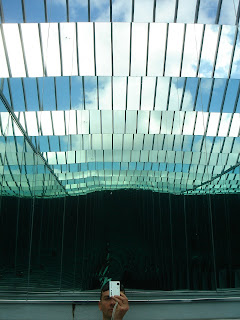
I mentioned in my inaugural post how I came to realize that an architectural piece that I saw on a trip to Berlin (in 2003), turned out to be an installation by Olafur Eliasson. At the time of my trip, I did not know who Eliasson was, or that what I saw was an art installation. I thought what I saw was an example of a modern element that Germans are so good at adding to everyday architecture, often in unexpected places. While doing research recently for my post on Olafur Eliasson (at the Margulies Collection in Miami) though, I learned that what I saw in Potzdammer Platz was in fact his work. Entitled Windspiegelwand (I think it translates as Wind Wound Mirror), it is a series of mirror plates that line the sides of a building. The mirror plates move freely with the wind, reflecting the sky at different angles. It was very pretty to look at. Above is the photograph that I took at the time. As you can see there were other art pieces there: larger than life rose sculptures that seemed to be floating on the pond and a sculpture on the other side. Are they still there? I don't know. May be my visitors from Berlin can respond?

This is a perfect example of what I love about contemporary art: The discovery. What I saw a few years ago turned out to be a piece by an artist that I later came to know and appreciate. The Berlin trip was an eye-opening experience. I borrowed a friend's amateur camera, loaded it with black & white film, and clicked away to capture modern architecture all around town. It is one of my most memorable trips.

The Devil Wears Prada


The Margulies has a sizable collection of vintage and contemporary photographs. The German photographer Andreas Gursky is well represented with his large scale works. I like his photograph of a Prada shoe display (Prada I). Here he captures something that is already a piece of art on its own. The store display (as a purely commercial endeavor) is so artfully done that you wonder how much the photographer contributed to it to make it his own artistic piece. But then, that may be the exact thought that he may have wanted to provoke with the viewer: The interplay between the subject, and the photographic image of the subject as distinct pieces of art.


Another one of his photographs is an image of the altar inside the Pergamon Museum in Berlin. Here, the artist's large scale photo initially makes you view the whole image from afar, and then get closer to look at the details. Gursky digitally manipulates the image to add interest. You end up observing the viewers in the photograph individually. What are the two men on the far right side (one of whom appears to be a restoration worker in a white uniform) discussing? Some of the viewers seem to be completely focused on the altar, while a few others seem to be oblivious.