skip to main |
skip to sidebar
The Russian Pavillion was one of the most engaging, and certainly the boldest in the Biennale. There was no room for quiet contemplation here. An installation by Alexei Kalima, Victory Over the Future, was in a room painted with figures of an audience on all four walls, accompanied by a cheering sound that got louder by every second. And all of a sudden, Boom!
Play the video below with sound on high.
The installation made viewers feel like they were on a stage in front of a huge live audience, in a concert or a soccer game. It gave the viewer a sense of unease and excitement at the same time. When the lights came on and the audience disappeared out of vision, your 15 seconds of fame was up. The fantasy all disappeared in a second and made the viewer crave for more and want to stay for another cycle of this looping video.
The Venice Biennale has international pavillions that showcase art from different countries by their own artists. The Danish and Nordic Pavillion was exceptional in that it featured international artists in two fictional domestic environments, curated and staged by the artist duo Elmgreen & Dragset. The first featured a fictional house that went on sale after a family supposedly broke up. Things were not what they seemed to be.

In the fuzzy picture above a sculpture of a house maid is cast in gold which contrasts with your traditional image of a maid. A chair seems to dissolve into the ground as a sign of decay, a theme that ran thru the entire house.
 A set of stairs did not seem to be functional or leading up to anywhere as it was supposed to. A richly-set dining table (not pictured) was fractured in the middle, including the plates on it, overlooked by a collage of signs made by street bums from across the world, begging for money, in contrast to the once idyllic scene of modern family life. Read NYTimes T Magazine feature on this pavillion.
The second exhibit space in the Danish & Nordic pavillion was a well-appointed modernist house furnished with iconic scandinavian furniture and provocative art.
 Visitors approached the residence from the pool where a dead body greeted them floating in the pool, either as a result of murder or suicide, leaving the visitors in suspense of a mystery unfolding.
 There was a narrative developing as visitors entered the residence and started viewing the Polynesian sculpture having a dialgoue with its modern counterpart next to it, a black and white photograph by Wolfgang Tillmans, with naked men lazing down on a lawn.

 While proceeding further into the residence, visitors encountered two paintings by Hernan Bas, a Miami artist known for his gay themes (Please see my April 2009 posting for more on Hernan Bas).

 Next installation revealed a set of Tom of Finland drawings with depictions of men having raunchy sex, further moving the viewer into a gay subtext
.

Next was a pair of sculptures of Michalengelo's David by controversial New York artist Terence Koh,
adding a contemporary interpretation of a classical work (and a prominent gay icon).

Behind the minimalist living room organized around a fireplace was a set of Vibeke Slyngstad paintings that hinted at the fictional resident's sophisticated collecting taste.

 As one approached the corner end of the house, a desk built by Simon Fujiwara revealed the mystery to the entire residence/installation. A manuscript on a typewriter; a collection of photographs; and clippings revealed a suspense novel in the making, in which the protagonist, a rich gay collector, ends up drowning in his own pool. The suspense was over. All the pieces of art now came together to complete a narrative and solve a puzzle for visitors who did not know what they were getting into in the first place. It was a very clever installation.
 The Danish and Nordic Pavillion set itself apart from the other international pavillions by telling a story though international artists' work rather than representing national artists for self promotion.
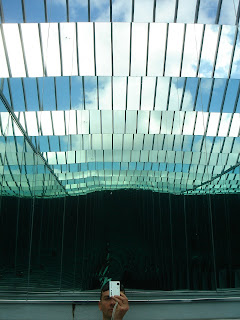
On a parting note, i could not resist the construction of the ceiling in the pavillion.
The Danish and Nordic Pavillion set itself apart from the other international pavillions by telling a story though international artists' work rather than representing national artists for self promotion.
On a parting note, i could not resist the construction of the ceiling in the pavillion.

 The 53rd insallment of the Venice Biennale, the international art exposition, runs until November 22 this year. It has a curated exhibit that feature art from international artists in il Giardini and Arsenale, and throughout the city of Venice. The exhibit is called Making Worlds, curated this year by Daniel Birnbaum, of art as a representation of a vision of the world, and as a way of “making a world”, in his words.
 American conceptual artist John Baldessari's words "I will not make another boring art" greets visitors in the Grand Canal.
 In the Giardini, Making Worlds opens with Argentine artisit Tomas Saraceno's installation. It is a renditon of an astronomical constellation based on the architectural structure of a black widow's web. It can suspend heavy weghts through the use of complex geometry. The result is visually stunning. Visitors walk through the structure, making it an interactive work.

 Next up is Swedish Artist Nathalie Djurberg's vision of apocalypse. Djurberg is known for her claymation videos, animation with clay figures. In this room she built a surealistic Garden of Eden in which nature has turned into something out of hell.

As you walk through the "garden" with huge carnivoreous plants and watch her films projected on 2 screens, you are confronted with innate fear of what's not understood.

The films depict disturbing subject matter and are politically charged, exposing the underbelly of institutions and traditions that we hold sacred. It is a very emotionally charged piece. I tried to capture the installation, but the room is dark, and i could not film the whole film sequence.
The next work by Hans-Peter Feldman, Schattenspiel (Shadowwork), with the artist's collection of toys and ordinary objects rotating on platforms lit from behind, cast their shadows on the wall like magic lanterns and looked like shadow puppetry.